Tiny homes pack a lot of personality into a small footprint, and the exterior is where that character first hits the eye. Whether you’re building from scratch, renovating a pre-fab unit, or upgrading a RVIA-certified trailer, the choices you make on siding, color, windows, and roofing define whether your home blends in or stands out. Done right, a tiny home exterior balances aesthetics with practicality, protecting against weather, maximizing natural light, and adding resale value. This guide walks through material selection, design strategies, and functional upgrades that work within tight dimensions and tighter budgets, so your tiny home delivers curb appeal without compromising durability or code compliance.
Table of Contents
ToggleKey Takeaways
- A tiny home exterior requires thoughtful design that balances aesthetics, weather protection, and weight management to maximize durability and resale value.
- Metal siding and fiber cement offer excellent durability for tiny homes, while vinyl is budget-friendly but requires careful maintenance in cold climates.
- Light colors like white and cream make small exteriors feel larger, while two-tone color schemes with darker accents create visual depth without overwhelming the space.
- Strategic window placement maximizes natural light and ventilation, with standard stock sizes (24×36 or 30×48 inches) offering cost savings during tiny home construction.
- Metal roofing and architectural asphalt shingles are top choices for tiny homes, balancing weight, longevity, and aesthetic appeal across different climate zones.
- Outdoor additions like decks, porches, and awnings effectively double usable living space while proper flashing and fasteners prevent water damage and ensure structural integrity.
Why Your Tiny Home Exterior Deserves Thoughtful Design
A tiny home’s exterior isn’t just about looks, it’s the first line of defense against wind, rain, UV exposure, and temperature swings. With a smaller surface area, every square foot of siding, trim, and roofing works harder than it would on a conventional house. Poor material choices or sloppy installation show up fast, leading to water intrusion, heat loss, or premature wear.
Thoughtful design also impacts livability. Strategic window placement brings in daylight and ventilation, reducing reliance on artificial lighting and HVAC. Color and texture choices can make a 200-square-foot home feel larger or more grounded in its setting. And if you’re on wheels, weight matters, every pound of siding, shingles, and trim counts toward your trailer’s GVWR (gross vehicle weight rating).
Finally, aesthetics affect resale and zoning. Some jurisdictions and HOAs have design standards that reject the “shed on wheels” look. A well-executed exterior signals quality craftsmanship and helps your tiny home fit into neighborhoods, RV parks, or accessory dwelling unit (ADU) lots without friction.
Choosing the Right Siding Materials for Tiny Homes
Siding choice hinges on weight, durability, maintenance, and cost per square foot. Here are the most common options:
Metal siding (corrugated steel or standing seam) is lightweight, fire-resistant, and low-maintenance. A 26-gauge steel panel weighs roughly 1 pound per square foot and can last 40+ years with a quality finish. It’s a favorite for modern, industrial aesthetics and works well in high-wind zones. Downside: it dents easily and can be noisy in rain without proper insulation.
LP SmartSide and fiber cement (like James Hardie) offer a traditional lap-siding look with excellent durability. Fiber cement is heavier (2.5 pounds per square foot for 5/16-inch planks) but resists rot, termites, and fire. LP SmartSide is lighter and takes paint well, but requires repainting every 8-10 years. Both need flashing and a weather-resistant barrier (like Tyvek) behind them to prevent moisture issues.
Wood siding, cedar, pine, or engineered wood, brings warmth and texture but demands ongoing maintenance. Expect to stain or seal every 2-3 years in wet climates. Weight varies: 1×6 cedar lap siding runs about 1.5 pounds per square foot. It’s a good fit if you’re aiming for a cabin or rustic aesthetic and you’re prepared to maintain it.
Vinyl siding is the budget champion at under $3 per square foot installed, and it’s nearly maintenance-free. But it can look cheap, cracks in cold weather, and offers limited design flexibility. It’s fine for a utilitarian build but won’t win design awards.
Corrugated metal or board-and-batten combos are trending in 2026, mixing materials for visual interest. Pair metal on the lower half with wood or cement board above to balance cost, weight, and style. Whatever you pick, make sure fasteners are appropriate for your substrate (often 1/2-inch OSB or plywood sheathing over 2×4 studs on 16-inch centers). Use galvanized or stainless screws to avoid rust streaks.
Color Schemes That Make Small Exteriors Stand Out
Color is the fastest, most affordable way to transform a tiny home’s presence. Light tones, white, cream, pale gray, reflect heat and make the structure feel larger, which is why they’re popular in small space design. But all-white can read as sterile or bland. Adding a darker accent on trim, doors, or one gable breaks up the monotony and creates visual depth.
Dark exteriors (charcoal, navy, forest green, matte black) anchor a tiny home in wooded or rural settings and hide dirt better than light colors. They also absorb more heat, which can be a plus in cold climates and a drawback in hot ones. If you go dark, use a high-quality exterior paint with UV inhibitors (like Sherwin-Williams Emerald or Benjamin Moore Aura) to prevent fading. Expect to repaint every 7-10 years depending on sun exposure.
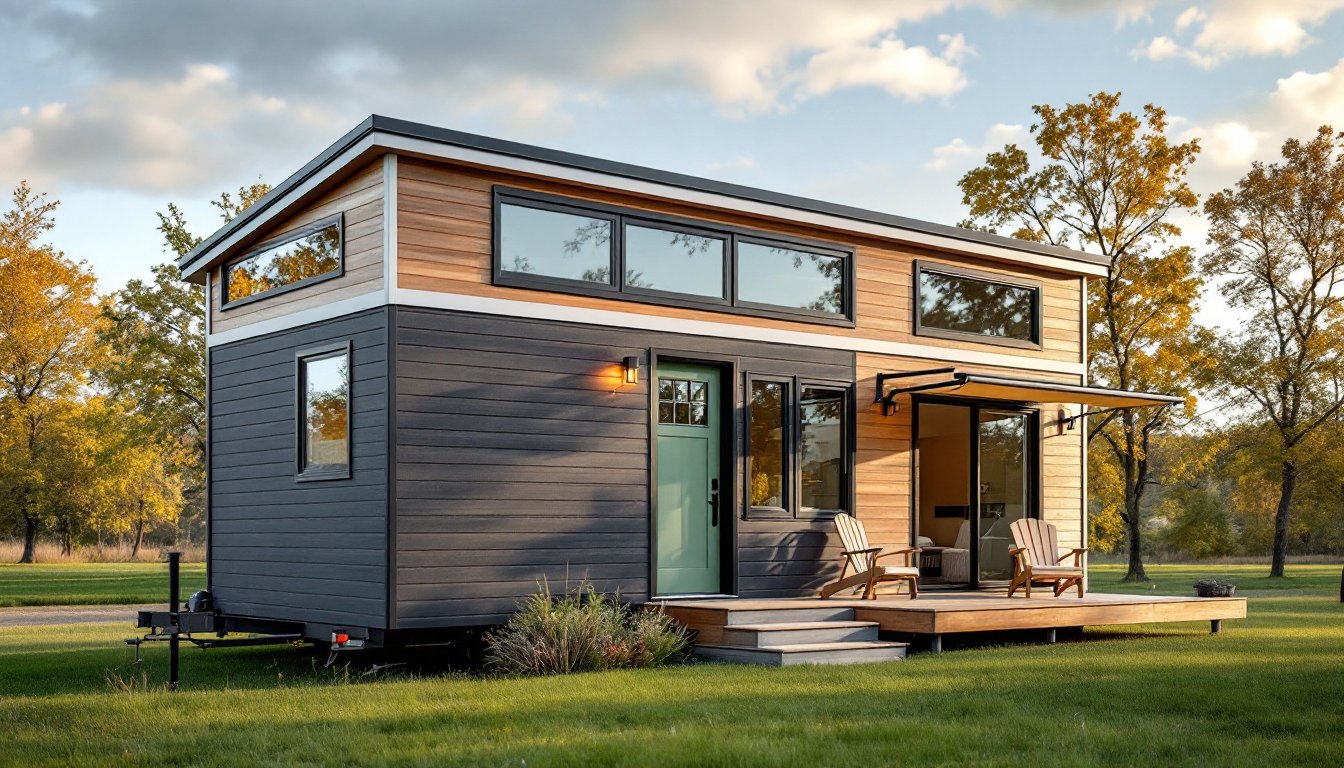
Two-tone schemes work especially well on small exteriors. Try a darker base color with lighter trim and fascia, or reverse it, light walls with bold window frames and a dark door. Vertical color blocking (one end or wall in a contrasting hue) can elongate the profile visually. Just keep it to two or three colors max: more than that looks chaotic on a small canvas.
Natural tones, cedar stain, weathered gray, earthy browns, suit off-grid or eco-focused builds. Stains let wood grain show through and require less frequent touch-ups than paint, but they don’t hide imperfections.
Before committing, test samples on a 2×2-foot scrap of your actual siding material and view it in morning, midday, and evening light. Colors shift dramatically depending on surroundings and sun angle.
Smart Window and Door Placement for Style and Function
Windows are your biggest ally for natural light and ventilation, but they’re also thermal weak points and add weight. Standard residential windows (double-hung, casement, or awning style) come in stock sizes, 24×36 inches, 30×48 inches, etc., which are cheaper and easier to source than custom cuts. Plan openings around these dimensions during framing to save money.
Placement strategy: Position larger windows on the long walls to maximize light and views without compromising structural integrity. Avoid clustering windows too close to corners: leave at least 16 inches from the edge to maintain shear strength in your wall framing. On the gable ends, smaller windows or a single statement window works better than multiple openings, which can weaken the truss connections.
Energy efficiency matters. Look for windows with a U-factor below 0.30 and an ENERGY STAR rating for your climate zone. Low-E coatings reduce heat gain in summer and heat loss in winter. Casement and awning windows (hinged on the side or top) seal tighter than sliders, making them better for mobile tiny homes that face wind loads on the highway.
Exterior doors should be 32 inches wide minimum for accessibility and furniture moving. A 36-inch door is better if you have the wall space. Steel or fiberglass doors outperform wood in durability and insulation. If you want a statement entry, paint the door a bold color or add a transom window above for extra light without sacrificing privacy.
French doors or sliding glass doors open up a tiny home to a deck or patio, blurring indoor-outdoor lines, a principle often seen in modern home design. Just confirm your floor framing can support the header span (typically a double 2×8 or engineered lumber beam) and that the door’s threshold is properly flashed to prevent water infiltration.
Roofing Options That Add Character and Protection
Your roof does more than keep you dry, it defines your home’s silhouette and affects heating, cooling, and snow load capacity. Most tiny homes use a gable, shed, or gambrel roof profile.
Gable roofs (two slopes meeting at a ridge) are the most common. They shed rain and snow well and provide usable loft space. Typical pitch is 6:12 or 8:12 (6 or 8 inches of rise per 12 inches of run). Anything steeper is harder to shingle and increases height, which can trigger zoning issues or clearance problems if you’re towing.
Shed roofs (single slope) suit modern, minimalist designs and are easier to frame, just a series of rafters on a slant. They work great for small footprints (under 150 square feet) but can limit interior headroom on the low side.
Gambrel or barn-style roofs maximize loft space but add complexity and weight. They’re popular on larger tiny homes (300+ square feet) where vertical space is at a premium.
Roofing materials:
- Asphalt shingles are cheap (roughly $1-$2 per square foot installed), easy to find, and come in dozens of colors. Architectural shingles (also called dimensional or laminate) last 25-30 years and look better than basic three-tab. They weigh about 2-3 pounds per square foot.
- Metal roofing (standing seam or corrugated) is lighter (0.5-1.5 pounds per square foot), lasts 40-50 years, and reflects heat, cutting cooling costs. It costs $5-$12 per square foot installed but pays back in longevity. Use concealed fastener systems to avoid leaks over time.
- Rubber membrane (EPDM or TPO) works for flat or very low-slope roofs. It’s waterproof and lightweight but doesn’t add visual character.
Safety note: Always wear a harness and use roof jacks or scaffolding when working above 6 feet. Tiny home roofs are small, but falls are just as dangerous. If your pitch is steeper than 6:12 or you’re not comfortable with heights, hire a roofer. It’s typically a one- or two-day job and costs $1,500-$4,000 depending on material and region.
Outdoor Living Additions: Decks, Porches, and Awnings
Outdoor living space effectively doubles your usable square footage in good weather. A deck or porch extends the tiny home footprint and serves as an entry transition, mudroom, or lounge area.
Deck framing basics: Use pressure-treated lumber for joists and beams (rated for ground contact, labeled .40 or .60 retention). Joists are typically 2×6 or 2×8 on 16-inch centers, spanning no more than 8-10 feet without a beam. Deck boards can be pressure-treated pine, composite (Trex, TimberTech), or tropical hardwood. Composite costs more ($3-$6 per linear foot) but requires no staining and lasts 25+ years.
Attach the deck ledger board to the home’s rim joist with 1/2-inch lag screws or structural screws every 16 inches. Use flashing above the ledger to prevent water from wicking into the wall cavity. If your tiny home is on a trailer, consult a structural engineer, attaching a permanent deck to a mobile home can create shear and torsion issues during transport.
Porches with a roof add covered outdoor space and protect your entry door from rain. A simple shed-roof porch (4×8 feet) requires four 4×4 posts, a 2×6 or 2×8 beam, and rafters tied into the home’s wall. Check local codes: some jurisdictions require frost footings (below the frost line, often 36-48 inches deep) even for small structures.
Awnings, retractable fabric or fixed metal, provide shade and rain cover without a full roof structure. A 6×8-foot retractable awning costs $300-$800 and mounts to the wall with lag bolts into studs. Fixed awnings (polycarbonate or corrugated metal on a simple frame) are more durable but permanent. Both reduce solar heat gain through windows by up to 65%.
Railings: If your deck is more than 30 inches above grade, most codes require a railing at least 36 inches high with balusters spaced no more than 4 inches apart (to prevent kids from slipping through). Use powder-coated aluminum or steel cable rail for a modern look, or traditional wood pickets for a farmhouse vibe.
Don’t forget lighting. Low-voltage LED deck lights (12V systems) are DIY-friendly and add safety and ambiance. Run the transformer inside or in a weatherproof box, and use outdoor-rated wire (14/2 or 16/2 landscape cable).
Conclusion
A tiny home exterior is a study in intentional design, every material, color, and detail serves both form and function. Start with durable, weight-appropriate siding and roofing, then layer in color and openings that enhance light and livability. Add outdoor space where it makes sense, and don’t skip the details: flashing, fasteners, and finish quality separate a polished build from a leaky regret. With careful planning and honest craftsmanship, your tiny home’s exterior can deliver curb appeal, weather protection, and long-term value, no matter the square footage.